Humanity's transcendence to a Type II civilization
Article on X: Humanity's transcendence to a Type II civilization (opens in a new tab)
From my conversation with Grok on humanity's transcendence to a Type II civilization (opens in a new tab)
Introduction
Humanity's transcendence to a Type II civilization on the Kardashev scale would represent a monumental leap in technological mastery, where our species (or its post-human descendants) harnesses and utilizes the entire energy output of a single star—equivalent to about 4 × 10^26 watts, or roughly 10 billion times Earth's current energy consumption. This shift, first conceptualized by Soviet astronomer Nikolai Kardashev in 1964, moves beyond planetary (Type I) limits to stellar-scale engineering, enabling god-like capabilities in energy manipulation, space expansion, and societal transformation. In the context of mature molecular nanotechnology (MNT) and ultra-cheap Starship fleets (as discussed), this could accelerate from our current Type 0.7-0.73 status to Type II in centuries rather than millennia, through exponential self-replication and resource abundance.
Key Features of a Type II Civilization
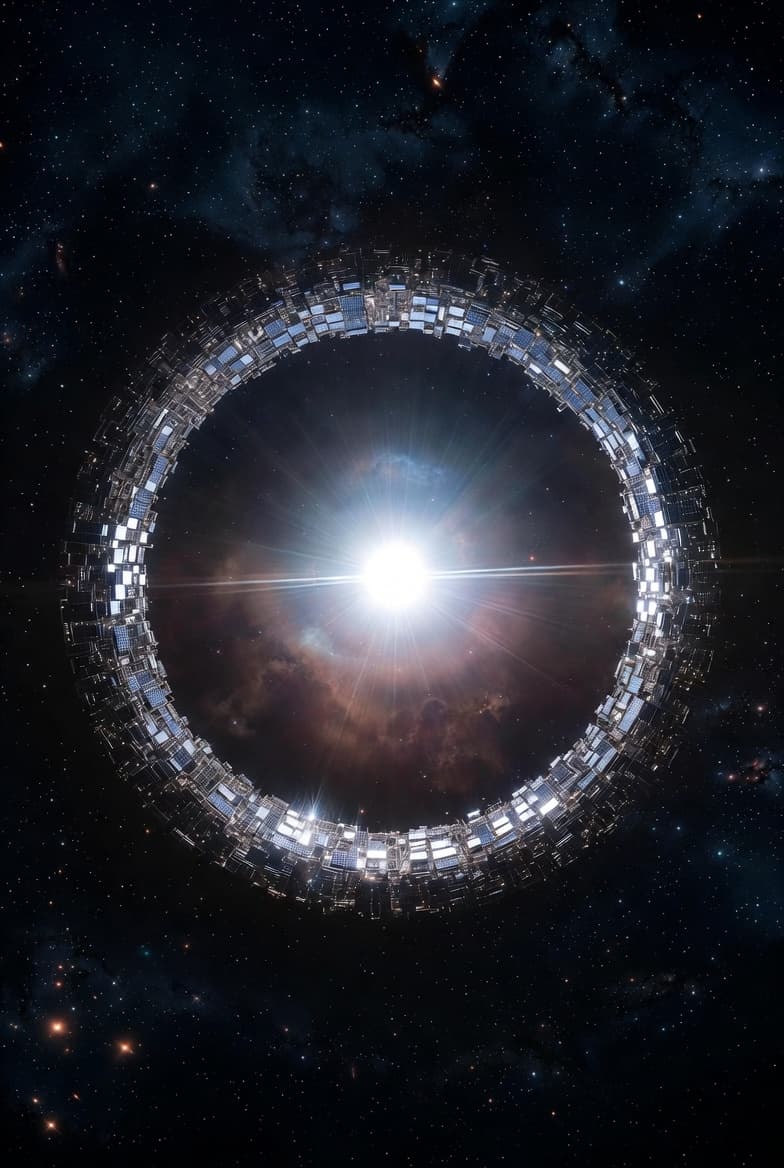
A Type II society would be defined by its ability to capture and direct stellar energy, likely via megastructures like Dyson spheres or swarms—vast arrays of orbiting solar collectors enveloping a star to absorb nearly all its radiation. This energy would power everything from interstellar travel to computational simulations of entire universes. Here's a breakdown:
-
Energy Harnessing and Megastructures: The hallmark is total stellar control. Imagine trillions of MNT-assembled solar sails or habitats forming a Dyson swarm around the Sun, converting its output into usable power with near-100% efficiency. This could include Matrioshka brains—layered Dyson shells functioning as colossal supercomputers for AI consciousness or virtual realities hosting quadrillions of simulated minds. Energy abundance eliminates scarcity, enabling feats like terraforming planets or accelerating particles to near-light speeds for research.
-
Solar System Domination: Full mastery of the home system, with colonies on every planet, moon, and asteroid. MNT-enabled Starships (costing <$10,000 each) would facilitate this by mining resources exponentially—e.g., disassembling Mercury for Dyson components or building O'Neill cylinders (rotating habitats) housing billions in orbit. Travel times shrink via advanced propulsion, like fusion drives or wormhole tech, making the Kuiper Belt as accessible as today's suburbs.
-
Societal and Biological Evolution: Humanity evolves into a post-biological or hybrid form. Nanobots enable immortality through body repairs or mind uploads to diamondoid substrates, blurring lines between organic and machine. Societies could be hive-minded via neural links, with AGI governing resource allocation in a post-scarcity utopia. Population explodes to trillions, spread across habitats, with cultural diversity preserved in virtual realms.
-
Technological Capabilities: Interstellar probes launched at relativistic speeds explore nearby stars, seeding new Dyson swarms. Communication spans light-years via laser networks or quantum entanglement. Environmental control extends to stellar engineering—e.g., stabilizing the Sun's output or mining its core for helium-3.
Path to Transcendence via MNT and Abundance
Starting from our 2026 baseline (Type ~0.73, harnessing ~10^16-10^17 watts via fossil fuels, renewables, and nuclear), MNT accelerates the timeline. Cheap, self-replicating Starships enable rapid solar system industrialization: Within decades, asteroid mining provides materials for initial orbital factories; centuries later, full Dyson construction begins. Estimates suggest 3,200 years without MNT, but with nano-abundance, it could be 100-500 years, as exponential growth compounds—e.g., nanobots doubling every hour to terraform worlds or build megastructures. Key milestones: Achieve Type I (planetary energy mastery) via global nano-grids and fusion; then scale to stellar via swarms.
Implications and Challenges
This transcendence ushers in immortality, infinite computation, and multi-stellar expansion, potentially leading to Type III (galactic) status. Earth becomes a preserved biosphere, while humanity's descendants roam as digital nomads. However, risks include energy monopolies, AI rebellions, or "great filter" events like self-destruction. Ethically, it demands equitable governance to avoid dystopias. Overall, it's humanity's ascent to cosmic relevance, where stars fuel our wildest dreams.