Time/Cost estimates for ground works with Nanobots Swarms
Article on X: Time/Cost estimates for ground works with Nanobots Swarms (opens in a new tab)
Introduction
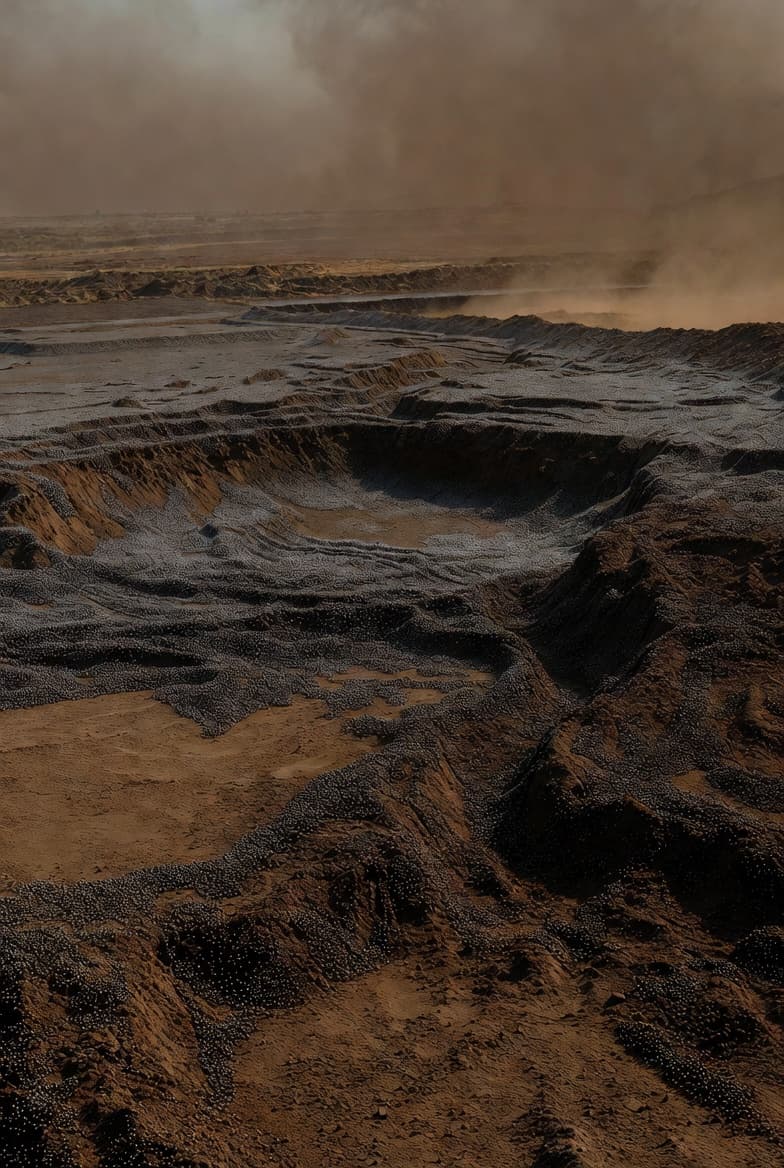
Under mature mechanosynthesis and coordinated nanobot swarms (best-case breakthroughs: exponential replication, atomic-precision disassembly/reassembly, AI-optimized parallelism, near-100% energy efficiency via chemical/solar harvesting, perfect thermal management, and reversible operations), all ground works become in-situ molecular processes. Swarms infiltrate soil/rock, break bonds atom-by-atom, sort/relocate atoms, and rebuild into optimized structures (foundations, liners, channels, reinforcements) with zero waste, no spoil, no vibration, and full integration of utilities/sensors. No macro equipment needed.
Core performance benchmarks (from molecular manufacturing literature):
-
A seed swarm (grams of bots) replicates exponentially (doubling every ~1–10 minutes) to trillions–quadrillions in <1–4 hours, saturating any site volume.
-
Throughput: Primitive desktop nanofactories achieve ~0.1–1+ kg product/hour per kg of machinery; advanced systems scale to kg/kg/hour or better via convergence and parallelism. Entire US-scale infrastructure (roads, bridges, cities — trillions of tons) replicable in ~1 week.
-
Effective processing: Atomic operations enable rapid volume transformation (meters-scale effective "excavation" per hour per swarm section once scaled). Limits are heat dissipation, energy input, and coordination — not mechanics.
Costs: Near-zero in post-scarcity abundance. Local atoms are free; energy use ~10–100 kWh/ton processed (recoverable in advanced designs) equates to pennies per ton today, or effectively $0. Energy is the only marginal input; swarms self-power via ambient sources. No labor, transport, or disposal costs.
Times are total end-to-end (deployment + replication + processing + verification/restoration). Water management is always integrated (nanobots create atomically perfect drainage channels, impermeable diamondoid liners, pumps, or selective-permeability zones simultaneously with other works). Estimates are conservative practical bounds; best-case could be 5–10× faster.
1. Site Clearing, Preparation, and Grading/Earthmoving
Swarms selectively disassemble vegetation/structures, level/reshape terrain, and compact/reinforce soil into load-bearing composites.
-
Small residential (single-family home, ~100–500 m³ moved): 15–45 minutes.
-
Low-rise/multi-family or commercial (~1,000–5,000 m³): 1–2 hours.
-
High-rise/skyscraper or industrial (~10,000+ m³): 2–6 hours.
-
Large-scale (e.g., airport site, dam foundation, thousands of hectares): 1–3 days (parallel swarms across area).
2. Excavation (Foundations, Basements, Trenches for Utilities)
Atom-by-atom removal and relocation; excess atoms converted in-place to fill, beams, or infrastructure.
-
Residential shallow foundations/basements (~100–1,000 m³): 20–60 minutes.
-
High-rise deep basements (~5,000–50,000 m³): 4–12 hours.
-
Utility trenching (km-scale for residential/commercial developments): 1–4 hours per km (integrated pipes/cables formed simultaneously).
-
Industrial/heavy foundations: 6–24 hours.
3. Soil Stabilization, Ground Improvement, and Piling/Drilling
Molecular cross-linking of particles into diamondoid-reinforced lattices or embedded sensor arrays; "piles" formed as integrated monolithic structures.
-
Any scale (residential to high-rise): 30–90 minutes post-excavation (overlaps with excavation).
-
Slope stabilization or liquefaction-prone sites: Same as above; full site in <2 hours.
4. Tunneling and Shafts
Swarms advance like a molecular boring front, lining with perfect composites and integrating ventilation/rail in one pass.
-
Small utility/service tunnels (residential or building connections, <1 m diameter): 1–2 hours per 100 m.
-
Vehicular/subway tunnels (5–10 m diameter): 12–48 hours per km (parallel front + replication along length).
-
Large infrastructure shafts/underground parking (high-rise): 4–12 hours.
5. Water Management (Dewatering, Drainage, Stormwater, Flood Control, Groundwater Barriers)
Fully integrated: Swarms create molecular sieves, channels, pumps, or hydrophobic/hydrophilic zones; pump or molecularly sequester water; form perfect liners or aquifers.
-
Site dewatering (any building excavation, handling groundwater inflow): Simultaneous with excavation — adds 0–15 minutes.
-
Residential drainage systems (foundations, yards): 10–30 minutes (embedded perforated channels + collection reservoirs).
-
Commercial/high-rise stormwater management (basement waterproofing, retention): 1–3 hours.
-
Large-scale (levees, flood barriers, km-scale drainage networks, dams/reservoirs): 1–7 days (parallel swarms reshape entire watersheds; atomically perfect impermeable cores with embedded sensors).
-
Aquifer remediation or artificial recharge: Hours for site-scale; days for regional.
6. Large-Scale or Specialized Ground Works (Applicable Across Building Types or Standalone)
-
Mining/quarrying for building materials: Selective atomic extraction — hours for building-scale volumes (integrated with foundation works).
-
Land reclamation/coastal stabilization: Days for hectares (builds artificial terrain + barriers).
-
Dam/embankment construction: 3–14 days for major structures (full atomic build from local sediment).
-
Planetary/continental terraforming (extreme best-case): Weeks–months for continent-scale reshaping.
Scaling notes by building type (all include full water management):
-
Single-family residential: Total ground works (clearing + excavation + stabilization + drainage + utilities): 30–90 minutes. Cost: ~$0.
-
Low-rise/multi-family: 1–4 hours.
-
High-rise/commercial skyscraper: Deep works + integration: 6–24 hours.
-
Industrial/warehouse: Larger footprints but shallow: 4–12 hours.
-
Infrastructure-linked (bridges, transit hubs): Adds tunneling/earthmoving — 1–3 days.
These timelines assume mature swarms are available on-site (delivered as seed packages). Ramp-up is the main variable; once at scale, works are effectively "instantaneous" relative to today (years → hours). Safety protocols (hard limits, kill-switches, non-replicating designs) ensure zero runaway risk. Environmental impact: positive — sites can be restored to pristine or enhanced states instantly.
This represents the upper-bound transformation: ground works shift from heavy industry to programmable molecular choreography, enabling arbitrary projects at negligible time/cost.