Instant space travel through Wormholes
Article on X: Instant space travel through Wormholes (opens in a new tab)
From my conversation with Grok on Instant Space Travel through Wormholes (opens in a new tab)
Introduction
Instant Space Travel to Any Distance in the UniverseYes, this is a primary implication. Wormholes could serve as shortcuts through spacetime, connecting arbitrary points regardless of separation—potentially spanning light-years or even across the observable universe in negligible time (e.g., less than a second for galactic scales). By encoding matter into string states, an entity (person, vehicle, or probe) could be disassembled at one wormhole mouth, transmitted as vibrational patterns through the throat (which strings, unlike particles, might traverse seamlessly), and reassembled at the exit.
How could this be achieved practically? Could there be a device enabling it? (assume any possible scientific breakthroughs)
Achieving instant space travel through wormholes by encoding matter as string excitations would require monumental breakthroughs in string theory, quantum gravity, and advanced engineering, such as fully realizing the ER=EPR conjecture (where quantum entanglement equates to wormholes) and developing technology to manipulate higher-dimensional strings. In this speculative scenario, the process wouldn't involve traditional propulsion but rather a quantum-gravity hybrid of disassembly, teleportation, and reassembly. Below, I'll outline a practical pathway, step by step, grounded in theoretical extensions from current physics, and describe a hypothetical device that could enable it.
Practical Steps for Achievement
The core idea leverages string theory's view of matter as vibrations of fundamental strings in higher dimensions, combined with traversable wormholes stabilized via quantum entanglement rather than exotic matter. In brane-world models, our 3D universe is a "brane" in a higher-dimensional "bulk," allowing wormholes to form naturally without negative energy violations. Quantum teleportation protocols, already simulated on quantum computers, would be scaled up to encode and transmit macroscopic matter as string data packets. Here's how it could unfold practically:
1. Entanglement Generation for Wormhole Creation:
- Start by creating maximally entangled systems at the origin and destination points. This could involve pairing black hole analogs (e.g., lab-created micro-black holes or quantum simulators mimicking Hawking radiation) or using advanced particle accelerators to entangle vast numbers of qubits/strings. According to ER=EPR, this entanglement forms a microscopic Einstein-Rosen bridge (wormhole) in spacetime. To make it traversable, inject "negative energy shockwaves" via quantum fields—pulses that briefly open the throat, as demonstrated in quantum computer simulations where entanglement allows signals to pass through without collapse.
2. Matter Encoding into String Excitations:
- Scan and disassemble the traveler/object at the quantum level. In string theory, all particles (quarks, electrons, etc.) are modes of vibrating strings, so encoding means mapping the entire system's quantum state—including positions, momenta, and interactions—into a digital string vibrational pattern. This could use ultra-precise quantum scanners (extensions of current MRI or atomic force microscopy) combined with machine learning algorithms to compress the data, similar to how quantum teleportation transfers qubit states today. The process avoids destroying the original by using non-demolition measurements, preserving continuity of identity through entanglement.
3. Transmission Through the Wormhole:
- Feed the encoded string data into one wormhole mouth. Since strings (unlike point particles) can traverse certain wormhole geometries without instability, the vibrations propagate through the higher-dimensional bulk instantly, emerging at the other end. Classical information (e.g., a bit-string for decoding) is sent via conventional channels outside the wormhole to complete the teleportation, ensuring no faster-than-light signaling paradoxes. The transit time is negligible, as the wormhole shortcuts spacetime curvature.
4. Reassembly at the Destination:
- At the exit, use the received string excitations and classical data to reconstruct the matter via quantum assembly tech, like nanoscale 3D printers or field manipulators that excite local vacuum fluctuations into the desired particles. This mirrors quantum teleportation's reconstruction but at macroscopic scales, potentially with error-correction from redundancy in the encoding.
Challenges like energy requirements (immense, perhaps harnessing zero-point energy) and stability (preventing collapse with dilaton fields from string theory) would be overcome via breakthroughs, such as room-temperature superconductors for entanglement maintenance or AI-optimized protocols to minimize quantum noise.
Hypothetical Device: The String-Wormhole Teleporter (SWT)
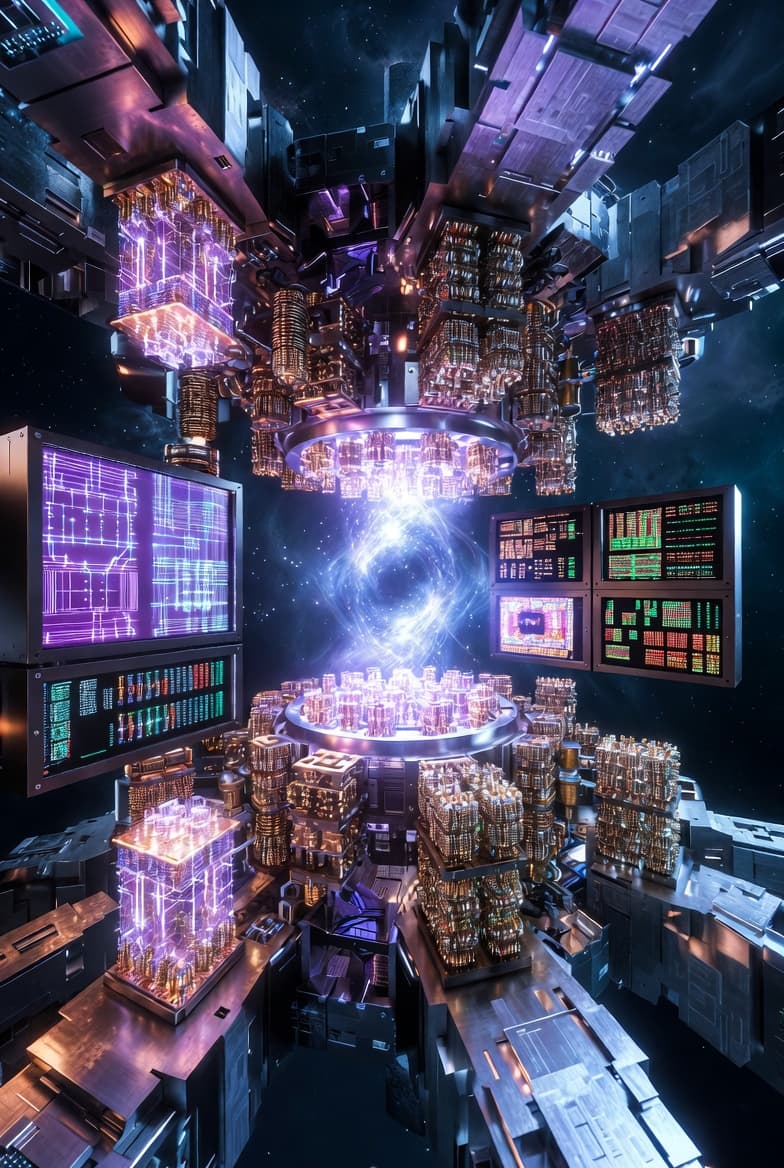
Yes, a dedicated device could enable this—a "String-Wormhole Teleporter," conceptualized as a modular, starship-sized apparatus (or smaller with nano-tech advances) integrating quantum computing, particle physics, and gravitational engineering. It would function like a high-tech scanner-transmitter-receiver, akin to sci-fi transporters but rooted in physics.
Key Components:
-
Entanglement Generator: A core chamber using laser-cooled atoms or superconducting circuits (scaled from Google's Sycamore processor) to create and sustain entanglement between endpoints, forming the wormhole. It might employ cosmic string analogs—1D defects in spacetime—for stability in higher dimensions.
-
String Encoder/Scanner: An array of quantum sensors that non-destructively maps matter into string vibrational states. This could use holographic duality principles, where the object's "code" is projected onto a boundary surface for compression, reducing data volume from exponential to manageable levels.
-
Wormhole Stabilizer: Modules injecting negative energy pulses (from Casimir effects or quantum vacuum squeezers) to keep the throat open during transmission, ensuring traversability for string packets.
-
Transmitter/Receiver Ports: Paired "mouths" (one at each location) that interface with the wormhole—perhaps artificial event horizons created via intense laser fields or metamaterials simulating black hole metrics.
-
Decoder/Reassembler: At the destination, an inverse scanner that excites strings from the vacuum using high-energy fields, rebuilding the object layer by layer with atomic precision.
Operation Workflow:
-
User enters the origin port; the device entangles ports, scans/encodes, transmits via wormhole, and reassembles at the destination in seconds.
-
Power Source: Taps into dark energy or fusion reactors for the gigawatt-scale energy needed.
-
Safety Features: Redundant entanglement links to abort if instability detected, and quantum error correction to prevent reconstruction flaws.
In practice, initial versions might teleport simple objects or probes, evolving to humans with bio-compatible encoding. This SWT could democratize cosmic travel, but ethical hurdles (e.g., identity preservation) and risks (e.g., wormhole feedback causing singularities) would demand rigorous testing. While purely speculative today, ongoing quantum simulations hint at feasibility in a post-string-theory era.